

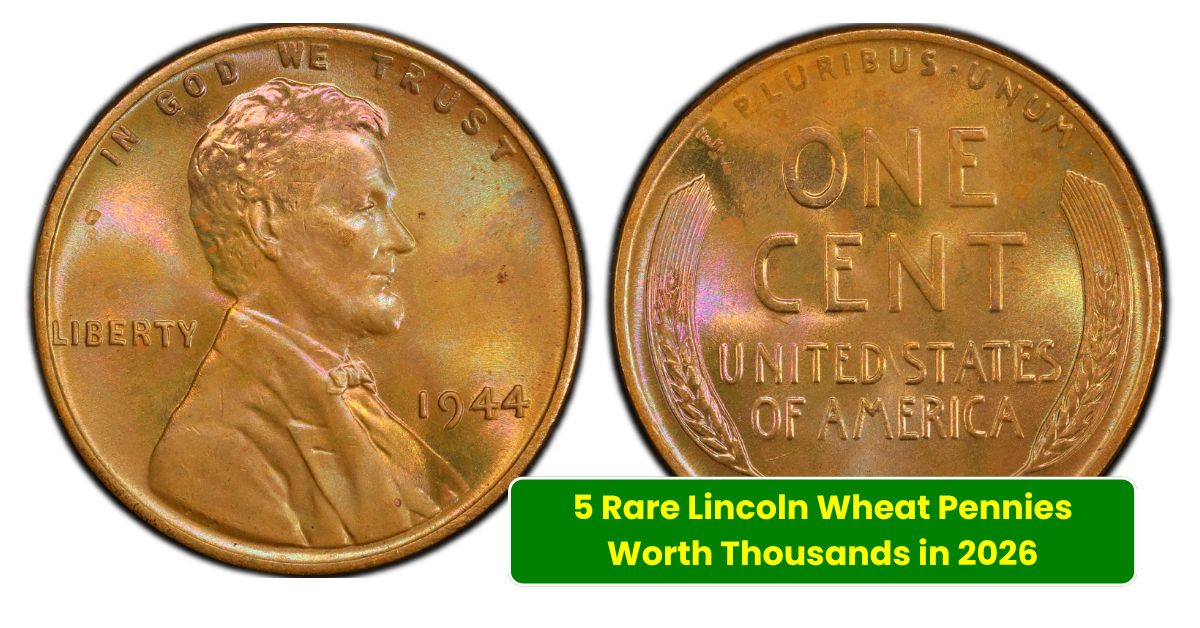
Lincoln Wheat Pennies may see like conventional ancient coins, but in 2026, a few of them are worth more than a brand-new car. That’s the portion that keeps collectors snared. A penny once hurled into a cash enlist or overlooked in a kitchen drawer can presently offer for thousands — some of the time indeed hundreds of thousands — depending on the date, mint check, and condition.
The Lincoln Wheat Penny to begin with showed up in 1909 to honor Abraham Lincoln’s 100th birthday. Planned by Victor David Brenner, the coin included Lincoln’s representation on the front and two wheat stalks on the switch. The plan remained in circulation until 1958, and over the decades, a few uncommon assortments discreetly got to be legends in the coin-collecting world.
Even presently, collectors over the U.S. are still looking through ancient jugs, bequest collections, and bank rolls trusting to reveal one of these covered up gems.
Why Certain Wheat Pennies Are Worth So Much
Not each Wheat Penny is profitable. In truth, most are worth as it were a few cents to a few dollars. But irregularity changes everything.
Some coins had greatly moo generation numbers. Others were struck with stamping botches that slipped into circulation some time recently the U.S. Mint taken note. Include verifiable noteworthiness and collector request into the blend, and abruptly a one-cent coin gets to be a genuine venture piece.
The U.S. Mint still gives verifiable coin data through its official site at https://www.usmint.gov, whereas collectors frequently confirm uncommon coins utilizing evaluating administrations like https://www.pcgs.com and https://www.ngccoin.com.
Here are five Lincoln Wheat Pennies that proceed overwhelming collector discussions in 2026.
1909-S VDB Lincoln Wheat Penny
If Wheat Pennies had sovereignty, this would likely wear the crown.
The 1909-S VDB penny was created amid the exceptionally to begin with year of the Lincoln cent arrangement at the San Francisco Mint. What caused the contention? The expansive “VDB” initials of originator Victor David Brenner printed on the turn around side.
Public feedback came rapidly, and the Mint evacuated the initials without further ado after generation started. That choice right away made rarity.
Collectors distinguish this coin by looking for:
- An “S” mint check beneath the date
- “VDB” initials at the foot turn around edge
- Only around 484,000 were stamped, a modest number compared to other pennies of the era.
- Coin Estimated Esteem in 2026
- Circulated 1909-S VDB $1,000–$3,000
- High-grade example $10,000+
A clean, red-colored illustration can bring surprising sell off prices.
1914-D Lincoln Wheat Penny
At to begin with look, the 1914-D looks standard. That’s what makes it perilous for casual collectors to overlook.
Produced in Denver, this penny had a generally little mintage, and numerous entered overwhelming circulation. Finding one nowadays with solid points of interest is fantastically difficult.
Counterfeits are too all over. A few individuals modify standard 1914 pennies by including fake “D” mint marks, which is why confirmation matters.
Professional evaluating companies stay fundamental when managing with high-value Wheat Pennies. The American Numismatic Affiliation moreover offers instructive assets for collectors at https://www.money.org.

Collectors particularly see for:
- Strong representation details
- Clear lettering
- Original surfaces without cleaning
In best condition, these coins routinely command a few thousand dollars.
1922 No D Wheat Penny
Now this one’s interesting since actually, it shouldn’t indeed exist.
In 1922, all Lincoln cents were struck at the Denver Mint, meaning each coin ought to carry a “D” mint stamp. But worn kicks the bucket and stamping issues caused a few pennies to show up without the stamp entirely.
That botch made one of America’s most popular blunder coins.
A honest to goodness 1922 No D penny shows:
- Weak or lost “D” mint mark
- Specific strike characteristics
- Particular kick the bucket wear patterns
Collectors regularly utilize amplification since fake illustrations are common.
- Feature Genuine 1922 No D
- Mint Mark Missing or about invisible
- Strike Quality Usually weaker overall
- Collector Demand Extremely high
Values can run from a few hundred dollars for worn illustrations to a few thousand for appealing specimens.
1943 Copper Lincoln Wheat Penny
This is the dream coin. Seriously.
During World War II, copper got to be fundamental for wartime generation, so the U.S. Mint exchanged to zinc-coated steel pennies in 1943. Most pennies from that year see silver-gray since of the steel composition.
But a few extra copper planchets from 1942 inadvertently remained in the presses.
The result? The amazing 1943 Copper Wheat Penny.
Only a modest number are known nowadays, making them among the rarest coins in American history.
Collectors more often than not perform a straightforward magnet test:
- Steel pennies stick
- Genuine copper illustrations do not
That said, fakes are greatly common. A few scammers copper-plate steel cents or change dates from 1948 pennies.

Auction costs for bona fide cases have surpassed hundreds of thousands of dollars, with first class examples coming to into the million-dollar run in past sales.
Yeah… for one cent. Wild.
1955 Multiplied Kick the bucket Wheat Penny
The 1955 Multiplied Pass on penny remains one of the most outwardly sensational blunder coins ever discharged into circulation.
Unlike unpretentious stamping botches, this one is self-evident nearly instantly.
The front lettering shows up multiplied, especially:
- “LIBERTY”
- “IN GOD WE TRUST”
- The date “1955”
The blunder happened amid pass on generation, meaning each coin struck from that pass on carried the same multiplying effect.
Thousands entered circulation some time recently the Mint caught the botch, and a few individuals allegedly found them in stash alter amid the 1950s.
Today, collectors still cherish this coin since the blunder is simple to see without favor equipment.
Condition Approximate 2026 Value
- Circulated $1,500–$3,000
- Mint State $10,000–$50,000+
High-grade ruddy cases stay particularly valuable.
Why Condition Changes Everything
Condition can totally change a coin’s value.
Two indistinguishable Wheat Pennies may vary by thousands of dollars essentially since one has superior surfaces or more honed details.
Collectors for the most part prefer:
- Original mint luster
- Minimal scratches
- Strong strike quality
- Natural color
Red copper coins are particularly prized since most more seasoned pennies obscure over time.
One critical run the show in the side interest: never clean ancient coins.

Cleaning frequently harms surfaces for all time and brings down collector esteem. Incidentally, a actually matured coin more often than not offers for more than a cleaned one.
Why Wheat Pennies Still Matter in 2026
Part of the request is history. These coins passed through American hands amid the Awesome Discouragement, World War II, and decades of financial change.
But there’s moreover the excite factor.
People really still find important Wheat Pennies in acquired collections and overlooked jugs. It doesn’t happen each day, clearly, but it happens sufficient to keep collectors searching.
For fledglings, Wheat Pennies are too one of the most straightforward passage focuses into coin collecting since they’re reasonable, recognizable, and pressed with stories.
Final Thoughts
Lincoln Wheat Pennies proceed demonstrating that little alter can hold gigantic esteem. From the notorious 1909-S VDB to the amazing 1943 copper cent, these coins stay a few of the most energizing treasures in American numismatics.
Most Wheat Pennies won’t make anybody wealthy overnight. But each collector knows the plausibility exists — and truly, that’s half the fun.
Somewhere out there, another uncommon penny is likely sitting unnoticed in an ancient drawer right presently.
FAQs
How can I tell if my Wheat Penny is valuable?
Check the date, mint mark, and overall condition. Rare dates like 1909-S VDB, 1914-D, and 1943 copper pennies are especially valuable.
Are all 1943 pennies valuable?
No. Most 1943 pennies are steel and worth modest amounts. The rare copper versions are the valuable ones.
Should I clean old Wheat Pennies?
No. Cleaning usually lowers collector value because it damages the original surfaces.
Where can I authenticate a rare penny?
Professional grading companies like PCGS and NGC can verify authenticity and assign official grades.
Can valuable Wheat Pennies still be found in circulation?
It’s rare, but yes. Collectors occasionally discover valuable coins in old collections, rolls, and inherited jars.